Jason M. Barr April 14, 2026
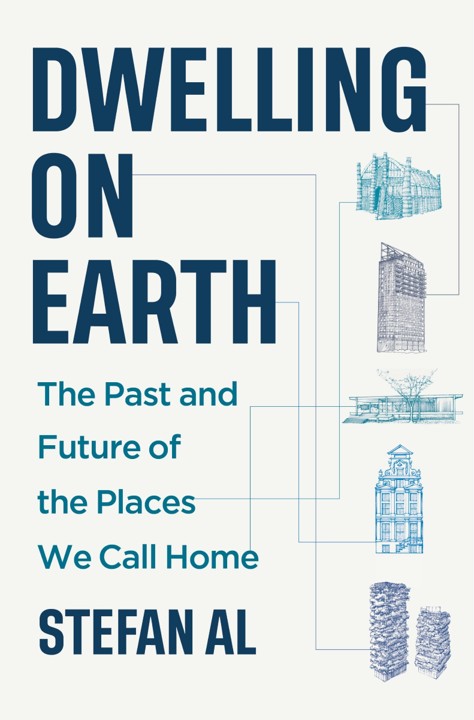
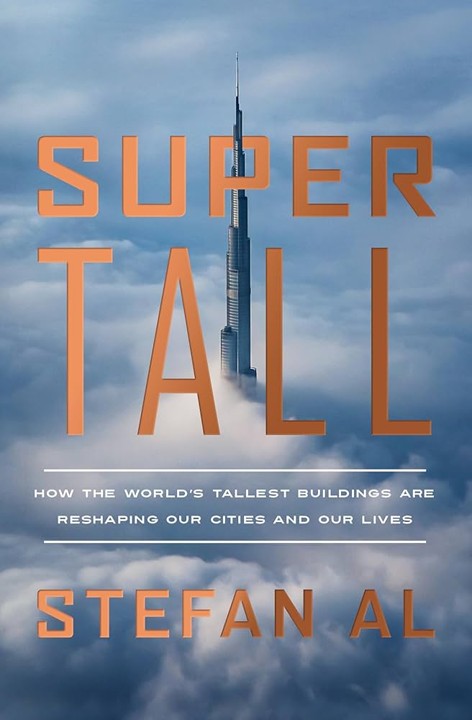
Stefan Al’s latest book is Dwelling on Earth: The Past and Future of the Places We Call Home (Norton, 2026). His previous book was Supertall: How the World’s Tallest Buildings Are Reshaping Our Cities and Our Lives (Norton, 2022). Al earned a Ph.D. in City and Regional Planning from the University of California, Berkeley. He is a practicing architect and has taught at Virginia Tech, Columbia University, Pratt Institute, the University of Hong Kong, and the University of Pennsylvania. He currently teaches in the Urban Policy & Planning Department at Hunter College, City University of New York.
About the Book
JB: Dwelling on Earth is, roughly speaking, a one-million-year history of human housing and habitation. What inspired you to take such a long-run perspective?
SA: When you take a long view, you find some fascinating parallels between our distant ancestors. Our fundamental building impulse, for instance. We can trace it back to roughly 476,000 years ago at Kalambo Falls in Zambia, where someone fitted two interlocking timbers together—the earliest evidence of a capacity to create a built environment, long before Homo sapiens even existed. From those simple timbers, we have come a long way, via Mesopotamian mud cities and Roman concrete multi-apartment buildings to today’s soaring skyscrapers and sensor-equipped “smart” homes—and possibly soon, 3D-printed moon habitats. But the impulse remains.
Surprise Findings
JB: In your research for the book, what surprised you the most about housing in the past? What types of housing did you find most intriguing and why?
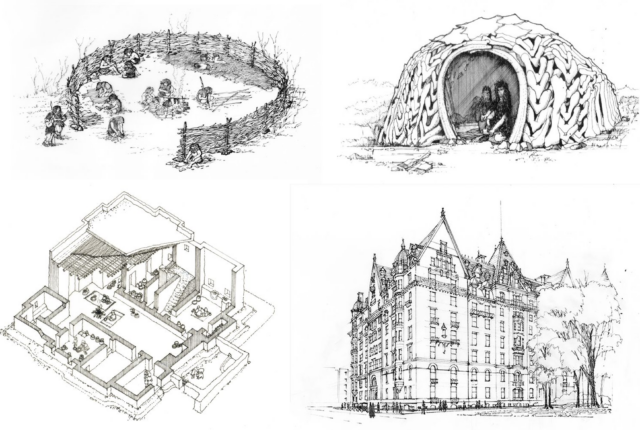
SA: Of course, dwellings take so many different forms, with variations driven by culture, climate, resource availability, and people’s personal preferences. Nevertheless, one big surprise to me is how many early solutions to dwelling were almost universal, as if we were bound to stumble upon them, because they were common sense. The pit house emerged independently in the Levant, in the Yellow River Valley, in Eastern Europe, and in the Sonoran Desert. Without the masonry skill to erect freestanding walls, societies used the earth itself to provide natural walls. Better still, these semisubterranean structures offered superior insulation, remaining warm in winter and cool in summer.
The other example is that when early settlement communities became better farmers, they virtually all shifted from building circular to rectangular homes—not just in the Near East but across Mesoamerica and Asia. Building rectangular was simply more convenient than round forms to expand homes and cluster them together in a denser settlement.
There are many more examples, from the courtyard house to the street grid—appearing independently in cultures with no contact whatsoever. It’s as though the impulse to build—and the many early forms this took—is part of humanity’s DNA.
Grand Lessons
JB: What do you think are the grand lessons from a long-term view when it comes to both housing and urbanism?
SA: One grand lesson is that housing is never just about shelter—it has broader implications for urbanism, health, social interaction, and the environment that we don’t always consider. In car-centric suburbs, daily walks give way to long commutes, contributing to rising rates of diabetes, heart disease, and obesity. Dense apartment living can limit natural light, affecting mental health—though it can also foster social connection. Even those who live in a house with stairs may live longer, benefiting from the daily cardiovascular exercise. These second-order effects are enormous, and they’re shaped by design choices that seem mundane at the time.
One recurring theme is the continuous struggle with the environment. The specifics vary, but the pattern is consistent. Take ‘Ain Ghazal in the Jordan Valley. About nine thousand years ago, villagers upgraded their homes by plastering floors and mud-brick walls with lime, which made them more water-resistant. But producing lime required wood for burning limestone at extreme temperatures, accelerating deforestation. Trees vanished within a three-kilometer radius. The soil eroded, crop yields shrank, and the village was abandoned.
In Mesopotamia, the same pattern played out at a larger scale—widespread deforestation set off a cascade of salinization and soil degradation that lingered for millennia. The lower stretches of the Euphrates and Tigris, once cloaked in palm and poplar, now lie barren as stretches of desert. In some areas, the soil has become so saline that modern attempts to make sun-dried bricks result in weak bricks that are no longer suitable for construction.
Angkor in Cambodia is perhaps the most dramatic case, and new technology has changed what we know about it. Recent lidar surveys reveal that at its peak in the twelfth century, Angkor sprawled over 350 square miles—dozens of times larger than Rome. What seems like untouched jungle today was once a vast metropolis of dispersed dwellings supported by an elaborate water management system of canals and reservoirs. When climate instability hit, that heavily engineered landscape became its Achilles’ heel. The very complexity that was once its strength made it impossible to maintain as the population declined. These sprawling civilizations proved less adaptable than compact cities like Rome, which—though battered—survived. As today’s megalopolises sprawl ever outward amid accelerating climate change, these fates offer a sobering parallel.
Dwelling on Earth vs. Supertall
JB: Your previous book, Supertall, was a chronicle of the forces driving the rise of supertall skyscrapers around the world. What connections do you see across the two books? How does the quest for supertall buildings relate to our quest to find better or novel forms of living, if at all?
SA: In a way, Dwelling on Earth is the prelude to Supertall, since it covers much of the story of building prior to the world’s tallest towers today. But both books are animated by the same fundamental questions: what are the ways in which we have shaped our buildings and how did they shape us in return?
There’s a personal connection behind the two books, too. I’ve designed tall buildings as an architect and that was in large part the inspiration for Supertall. But as a resident, I’ve lived in strikingly varied homes—a Dutch row house where I cycled safely to school, a communal student residence in Delft with kitchens built for connection, a tiny apartment in Barcelona’s lively old town, a cleverly compact Hong Kong pencil tower, and later to American suburban homes from California to New Jersey. Living in these spaces revealed how deeply they shaped my daily life, relationships, and worldview. That personal journey sparked larger questions about how homes influence our social bonds, our sense of self, and our environmental footprint. I became fascinated by the full arc of human habitation—from the first rock shelters to today’s skyscrapers—and that led to Dwelling on Earth.
Homes and Cities
JB: How do you see the connection between home design and urbanism? Which drives which? And what are the key lessons about how we should build homes to foster better, more functional cities?
SA: In the world of archaeology, new discoveries of early “proto cities” are stirring up the debate around the beginning of cities. In these earliest settlements, the home probably drove urbanism. Tell Brak in Mesopotamia, for instance, six thousand years ago, had no sign of monuments such as palaces or temples yet it was larger than a hundred acres.
Households clustered together in neighborhood groups separated by open spaces—each cluster functioning almost like a traditional village but gradually becoming part of something larger. Urbanism there likely emerged from the bottom up, as the organic result of many households pursuing their own interests.
What drove people to create these unprecedented communities in Mesopotamia? One clue lies in a piece of volcanic glass. Obsidian, prized for its ability to be made into sharp tools, was likely the economic engine in Tell Brak. Imported from hundreds of miles away, this precious resource attracted people from far and wide. Each household became a workshop, which contributed to a network of decentralized production and trade. Organizing such exchanges required communication, coordination, and trust—which put these communities on a path toward growing complexity, a path toward urbanism.
Optimal Home Design
JB: One of the themes of your book is that before we had modern technologies, such as electricity, air conditioning, modern appliances and so on, homes were designed to better fit the environmental conditions in the places they were built. Do you think we should be designing our current homes with climate, weather, and sunlight patterns in mind? And if so, what would be gained by this design approach? Or can we just “power through” environmental conditions using modern technology?
SA: Prior to the industrial revolution, designing with climate was simply common sense. Even Socrates once turned his mind to the ideal home, articulating the essence of passive solar design—a southern overhang that offers comfort in all seasons. The ancient Greeks thought this was so obvious that the playwright Aeschylus mocked anyone who didn’t know it.
Today, though it is often forgotten, design with climate in mind still makes sense, and it doesn’t necessarily cost more. Orientation, geometry, ventilation—these are design decisions, not expensive add-ons. Insulation standards, too, are good examples. In Europe, building codes have long required meaningful standards for insulation and airtightness, and they’ve driven real results without making housing unaffordable.
One example in the US is what I call “obese buildings”—structures so deep and wide that they rely entirely on artificial lighting and cooling, cut off from natural light and air and almost impossible to adapt to new uses. This is a lazy way to build: we just throw energy at the problem instead of utilizing design to solve it.
The Affordability Question
JB: Your book does not go into the issue of housing affordability or the economics of home building, but from your research on the history of housing, did you get a sense of the ways in which cities were able to make housing affordable in the past? Is there a way that we can build homes that are both affordable and better designed for health and well-being?
SA: For most of human history, when populations grew, cities built—even in dense, difficult conditions. Romans invented insulae, multi-story apartment buildings made of early concrete. Amsterdammers squeezed canal houses onto sixteen-foot lots on reclaimed land. Brooklynites filled block after block with brownstones.
Yet today, in many North American cities, building codes and modern zoning have made this ‘gentle density’ nearly impossible to replicate. The row house, for instance, was the workhorse of housing in cities such as New York and Boston, yet is often not allowed. While some of these rules made sense at the time—tenement fires in New York led to requirements for two means of egress in apartment buildings over three stories—this was an era of wood-frame construction and no sprinklers.
Rules designed for 1900 have become 21st-century constraints. The modern dual-staircase mandate can add substantial costs to a modest mid-rise and effectively forces the “double-loaded corridor”: those long, windowless hotel-style hallways with units facing only one direction—a layout that eliminates the possibility of cross-ventilation and feels akin to a The Shining scene.
In this regard, North American cities are outliers. Most of Europe and Asia allow “single-stair” mid-rise buildings. Fortunately, many cities in the US are now recognizing this mistake, and re-allowing this “missing middle” housing.
And these medium-density, walkable neighborhoods offer something that single-use sprawl cannot. Despite covering just about 1 percent of land in major US cities, walkable areas generate 19 percent of the country’s GDP. Walkable, human-scaled communities are not some radical invention. They are a return to what cities once were.
On Modernism and Modern Architecture
JB: You talk about the Modernist conception of homes as “machines for living.” Do you see this Modernist view of making homes efficient, standardized, and inspired by factory machines and production as a useful model for how we should build our homes? What are the pros and cons of this aesthetic and philosophy for how we live?
SA: Le Corbusier declared that the house is a machine for living in, and the idea had enormous influence. In 1920s Frankfurt, Ernst May designed housing where each building faced south, deliberately spaced so sunlight would reach every apartment. These were real improvements for workers who had been living in overcrowded, unsanitary tenements. But there were costs. Critics would later coin the term “tombstone urbanism” to describe the derivative housing blocks that mimicked May’s parallel buildings but neglected the social infrastructure that made them work. The spaces between buildings often translated to windswept no-man’s-lands. And sometimes modernism’s pursuit of functionality was really a pursuit of universal aesthetics that trumped common sense.
I have a personal memory that captures modernism’s contradictions. On my graduation day, my mother’s heel caught in the steel grating of our Brutalist architecture school’s floor. Her offhand comment about the building’s odd hostility to its occupants struck a deeper chord—especially in a structure meant to teach future architects. It seems a fitting metaphor: a movement born from the desire to improve human life through rational design had, in its pursuit of aesthetic purity, sometimes created spaces that worked better as manifestos than as shelter.
Cities and the Automobile
JB: What ways did the automobile impact housing design? Do you see the automobile, on net, as a positive force for the way we live? Or do you think that car-based societies might have some downsides? If so, should we try to overcome our love of automobiles?
SA: The car is a fantastic and useful invention, but from an urban planning perspective. it takes up a lot of space compared to other modes of transportation. In some American cities, more than a third of downtown space is dedicated to parking. The car also transformed the home itself. Porches and front yards once served as social bridges between private life and the public street. But many homes turned inward—garage doors dominated facades and family life retreated to the backyard. This is not just a matter of building layouts, but also of health. Our hunter-gatherer ancestors took 16,000 to 17,000 steps per day; modern Americans average only 5,000. Every extra hour spent driving per day raises the risk of obesity by 6 percent.
Fortunately, many cities around the world are now re-prioritizing their streets from predominantly the car to all modes of transportation, and in particular “active” ones, like walking, biking, and taking public transit. As someone who is from the Netherlands and grew up on a bicycle, when I first moved to New York City in 2013, I was delighted by all the then-recent bikelanes.
Looking Ahead
JB: Looking ahead, what do you see as the major challenges to designing homes and cities that preserve health and well-being in the face of many potential challenges and problems that we face, including climate change, rapid advances in technology, and ongoing affordability problems?
SA: The central argument of the book is that these challenges—climate change, density, affordability—are not just problems to solve. They are opportunities to make our homes not only more resilient but genuinely more desirable. A well-insulated home is quieter and cheaper to maintain. A walkable neighborhood is healthier and more sociable. A building made from mass timber can be more comfortable than one made from concrete. Compact communities reduce the per capita infrastructure costs, which can lower the price of housing. Automation technology can make building cheaper and also more customizable.
As a phrase attributed to Buckminster Fuller puts it, “We are called to be architects of the future, not its victims.”
Read the Q&A Interview with Stefan Al about his book Supertall here.
Leave a Reply